

Tour operators run sophisticated businesses. A single food experience in a mid-size city involves reservation management, payment processing, guide scheduling, liability waivers, guest communication, review generation, email marketing, and often photo or video delivery. The software industry has noticed, and the number of tools available to operators has grown steadily over the past decade.
What is less obvious is where all of that software lives in the timeline of a guest experience. Picture a typical day. A guest books online weeks in advance. They receive a confirmation email, then a reminder, then a waiver link. They show up. The guide leads the experience. The experience ends. Hours or days later, a follow-up email arrives asking for a review. A photo gallery link shows up. Maybe a survey. Maybe a discount code for their next booking.
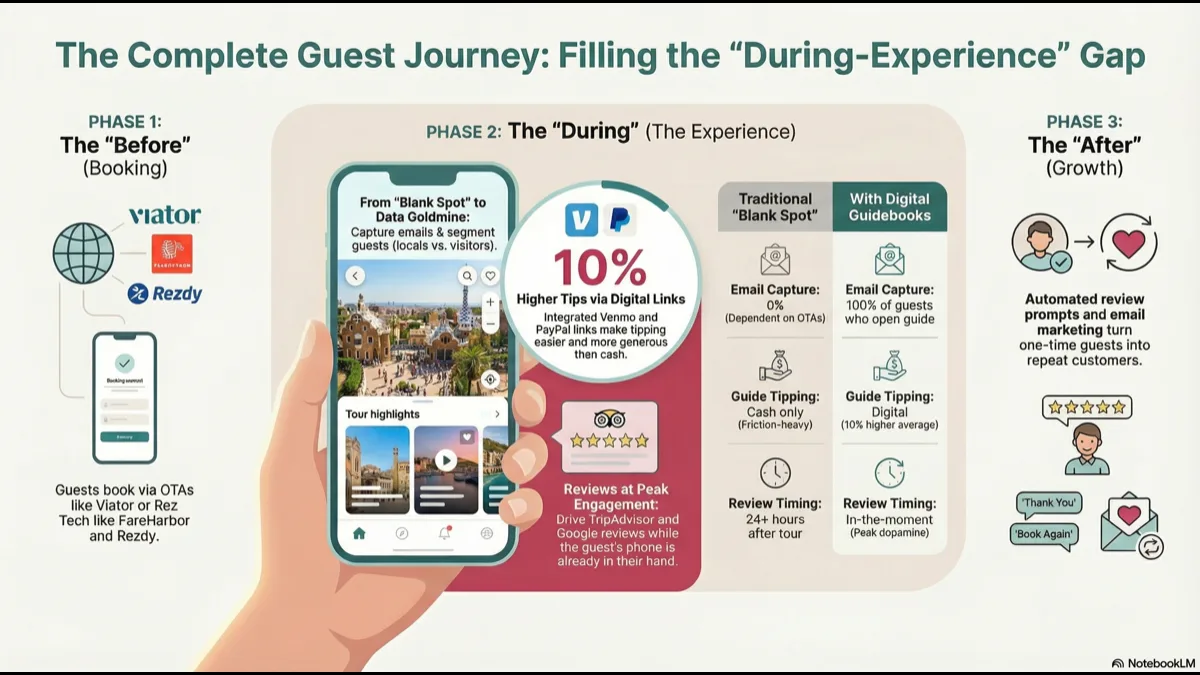
Nearly every tool in that sequence sits before the guest arrives or after they leave. The experience itself, the two or three hours when guests are most engaged, most grateful, and most likely to take action, is the phase with the least software attention. That is not a criticism of what exists. It is a description of where the industry has focused, and where it has not.
Before the experience
The before phase is the most mature category in tour operator technology. Booking and reservation platforms handle availability, pricing, payment processing, distribution to OTAs, and the entire checkout flow. This is foundational software. Without it, the business does not function.
The major platforms in this space include FareHarbor, Peek Pro, Rezdy, Xola, TripWorks, Checkfront, Rezgo, TrekkSoft, The Flybook, and Bookeo. Each has strengths in different markets, different price points, and different operator sizes. Some excel at high-volume activity operators. Others are built for smaller, boutique experiences. All of them do their primary job well: converting a website visitor into a confirmed reservation.
These platforms have expanded over the years to include features like automated confirmation emails, calendar syncing, staff scheduling, and basic reporting. Some offer integrations with accounting tools and CRMs. The ecosystem is competitive and well-funded, which means operators have real choices and the products improve steadily.
The important thing to recognize is that the booking platform's job ends when the guest shows up. It was built to get people to the meeting point. Once they are there, the platform has done what it was designed to do.
Pre-arrival communication
Between the booking and the experience itself sits a compliance and logistics layer. This is where waiver collection, pre-arrival messaging, and reminder sequences live.
Wherewolf is a well-known tool in this space, handling digital waivers and check-in. TourOptima provides SMS messaging and operational tools for managing guest communication. Many booking platforms include their own pre-arrival email sequences, sending the meeting point, parking instructions, what to wear, and what to bring.
This layer matters. It reduces no-shows, handles legal requirements, and sets expectations. But it is still pre-experience software. Its job is to prepare the guest for what comes next. The guest has not yet met the guide, visited the first stop, or had the moment that makes them want to tell their friends about it.
During the experience
This section is short because the category is nearly empty.
For the two or three hours when a guest is on a food experience, a walking experience, a history experience, or a pub crawl, there is almost no software designed for that window. The guide leads. The guests follow. Phones come out for photos of the food or the architecture. And then it ends.
This is the phase when guests are the most emotionally engaged. They have just tasted something remarkable or learned something they did not know about a city they thought they understood. They are standing next to a guide they genuinely like. They are in a generous, open, responsive state of mind. Research supports this: 65% of people tip more generously through digital methods, and digital tips average 10% higher than cash. The willingness is there. The moment is there.
Yet there is almost nothing in the guest's hand during this window that connects them to the operator's business goals. No email capture. No review prompt. No tipping interface. No feedback mechanism. The guide might mention a tip jar. They might verbally ask people to leave a review. But the software layer that exists before and after the experience simply does not exist during it.
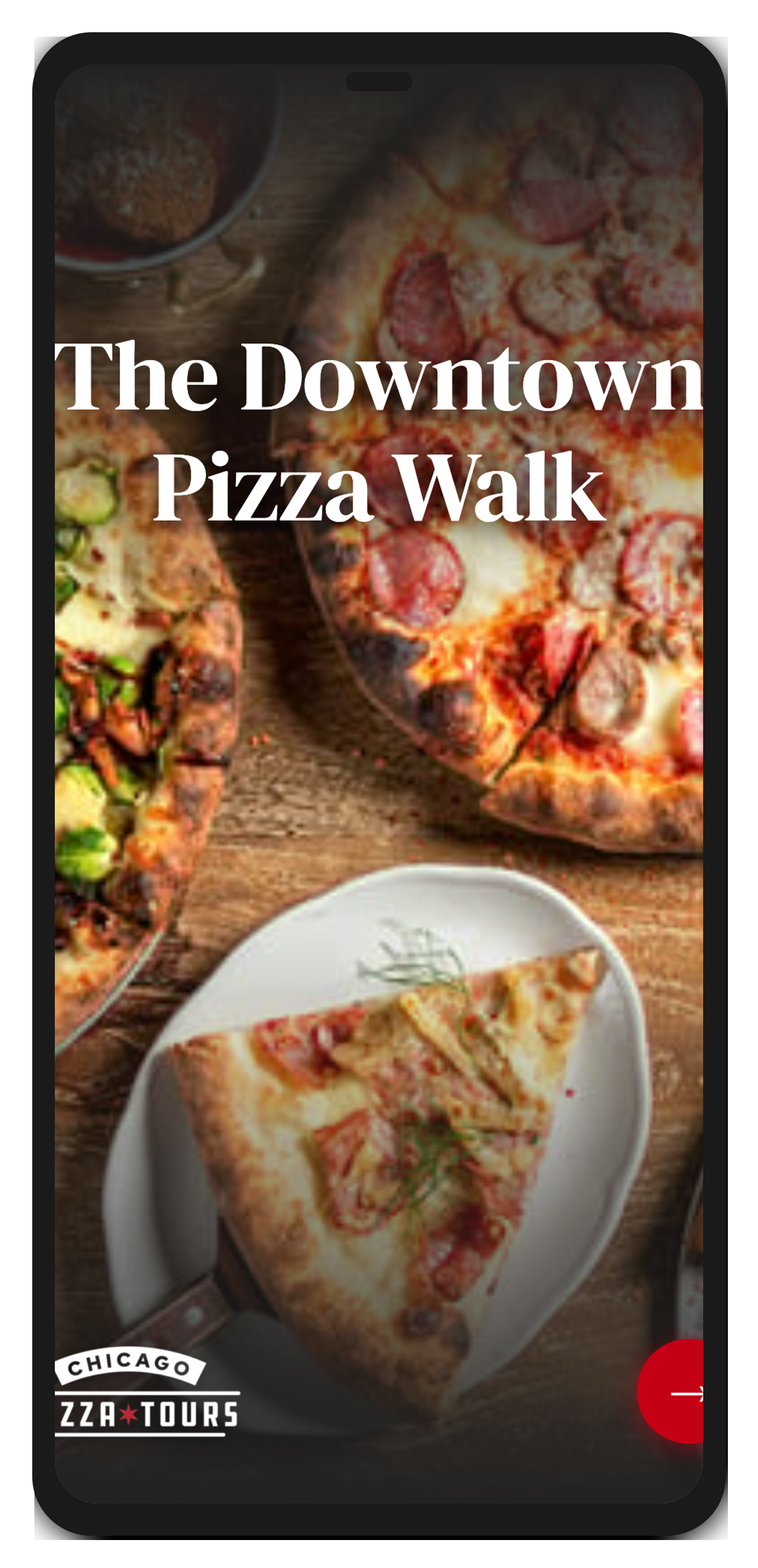
Digital Guidebooks was built for this phase. It is a browser-based tool that guests access on their phone during the experience, with email capture, guide-specific tipping, review prompts, and feedback built into the flow. It is not the only possible approach to this problem, but it is one of the very few products that occupies this specific window.
The window is also where content that has nowhere else to live finally has somewhere. A stop carries mixed media, including audio, so a story can play where it happened rather than being retold over traffic noise. And a photo wall keeps the photos those phones were already taking, which is the one asset in the entire stack that operators generate for free and then throw away.
After the experience
The after phase is where the industry's second wave of innovation has focused. Once the experience ends, a series of tools activate to capture value from what just happened.
Photo and video delivery is one of the more successful post-experience categories. Fotaflo built its platform specifically for experience operators, making it easy to share branded photo galleries with guests after they leave. The photos serve a dual purpose: they delight the guest and they generate social sharing, which functions as organic marketing.
Review generation is another well-developed category. Platforms like Podium and Birdeye help businesses of all kinds collect reviews, and tour operators use them alongside more industry-specific tools like TripAdmit. These platforms automate the ask, sending an email or SMS after the experience with a direct link to Google, TripAdvisor, or Yelp. The data backs up why operators invest here: 90% or more of travelers read reviews before booking, so a steady stream of recent, positive reviews has a direct impact on revenue.
Email marketing platforms like Mailchimp and Klaviyo serve operators who want to stay in touch with past guests, promote seasonal experiences, or drive repeat bookings. Survey tools like Typeform collect structured feedback that operators use to improve their product.
All of these tools are excellent at what they do. They are also, by definition, chasing a moment that has already passed. The review request arrives in an inbox 24 hours after the experience ended. The guest has returned to their hotel, gone to dinner, maybe flown home. They are no longer standing next to the guide who made them laugh. They are no longer tasting the dish that surprised them. The emotional peak that makes someone want to leave a five-star review is a memory now, not a feeling.
The gap between during and after
The pattern becomes clear when you lay the tools out by phase. Before the experience, operators have mature, competitive options. After the experience, they have solid tools that work hard to re-engage a guest who has already moved on. During the experience, almost nothing exists.
This is not because the during phase is unimportant. It is because the software industry followed the money. Booking platforms monetize the transaction. Review platforms monetize the reputation. Email platforms monetize the relationship. The during phase, the actual experience, has historically been harder to monetize because it is harder to digitize. The guide is the product. The walk is the product. The food is the product. Software felt like an intrusion.
What has changed is the phone. Every guest on every experience already has a phone in their hand. They are already using it to take photos, check maps, and text their friends. The idea that software during the experience is an intrusion does not hold when the guest is already interacting with their device. The real question is whether the operator has anything useful on that screen when the guest looks down.
Tools built exclusively for the after phase have to work harder because the emotional peak has passed. A tip prompt that appears via NFC at the end of a walking experience is a good product. A review request that lands in an inbox the next morning is a reasonable approach. Neither one captures the moment when the guest is still on the experience, phone in hand, feeling grateful and engaged. That is not a failure of those products. It is a limitation of where they sit in the timeline.
What a complete stack looks like
A tour operator who wants full coverage across all three phases would assemble something like this.
Before: A booking and reservation platform (FareHarbor, Peek Pro, Rezdy, Xola, TripWorks, Checkfront, or one of the other established options). A waiver and check-in tool if the booking platform does not include one (Wherewolf). Pre-arrival email or SMS sequences, either through the booking platform or a dedicated tool like TourOptima.
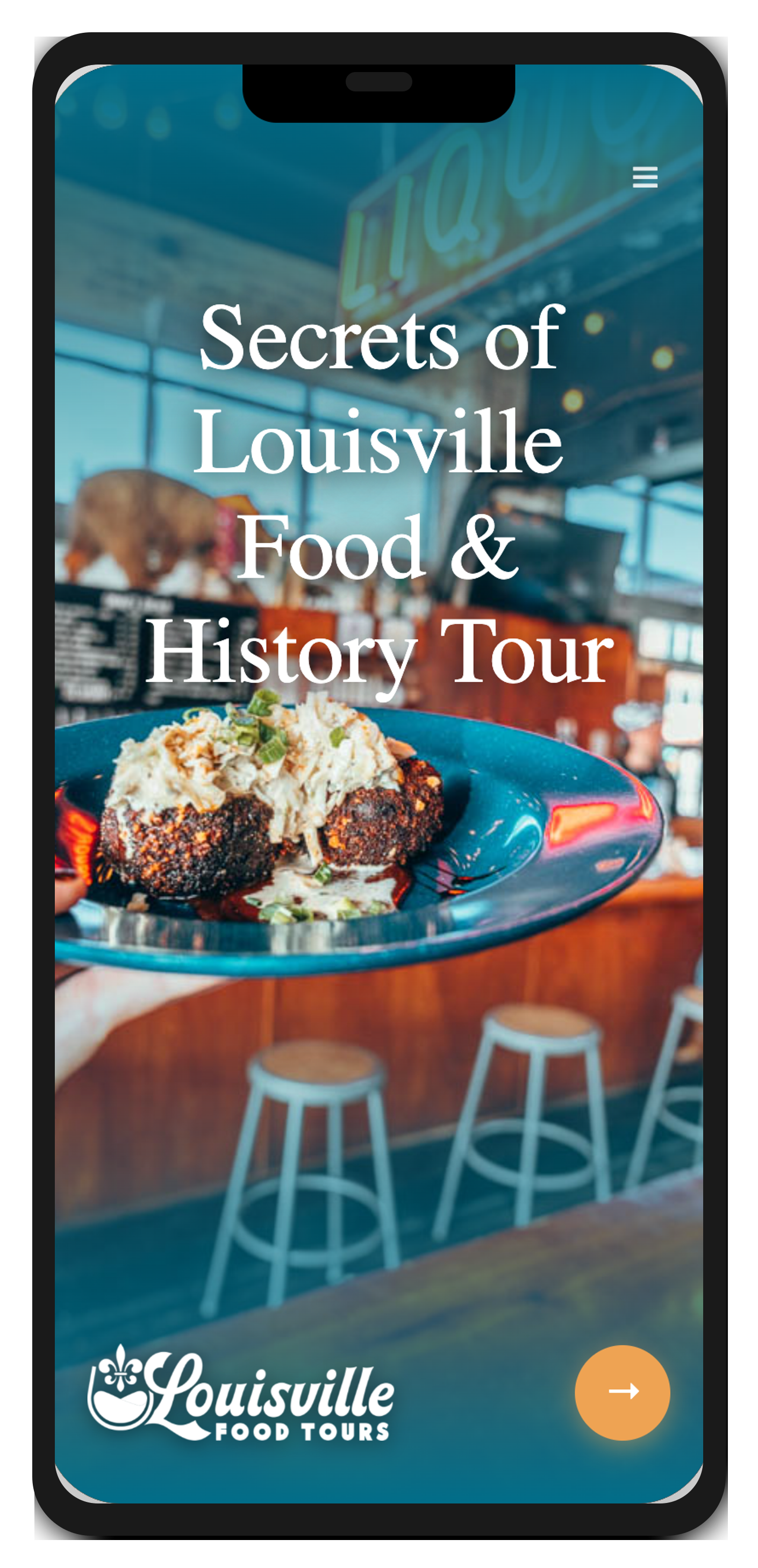
During: A guest-facing mobile tool that captures emails, enables tipping, prompts reviews, and collects feedback while the experience is still happening. Digital Guidebooks occupies this phase.
After: A photo delivery platform (Fotaflo). A review generation tool (Podium, Birdeye, or TripAdmit). An email marketing platform (Mailchimp or Klaviyo) for ongoing communication. A survey tool (Typeform) for structured feedback if it is not already handled during the experience.
Not every operator needs every tool. A solo operator running one experience per week has different needs than a company running forty experiences a day across three cities. The point is not to maximize the number of tools. It is to recognize which phases are covered and which are not.
A note on guide-facing software
Almost every tool described above is built for the operator or the guest. Very little software has been built for the guide.
Guides are the people who make the experience work. They are the reason guests tip, leave reviews, and come back. They are also, in most cases, independent contractors or part-time employees whose income depends heavily on gratuities. Their livelihood is directly tied to whether guests tip and how much.
In most of the existing tech stack, the guide appears as a calendar slot, a waiver collector, or a name in a scheduling system. The software does not help them earn more. It does not give them a profile that guests can connect with. It does not provide a digital tipping interface tied to their identity. It does not give them data on their own performance.
This is a gap that deserves more attention from the industry as a whole. Guides are not a line item in an operations dashboard. They are the human beings who make the experience worth reviewing in the first place. Software that treats them accordingly, that helps them earn a better living and build a professional identity, is overdue.
Auditing your own stack
The most useful thing an operator can do with this information is simple. Write down every piece of software you use and place it in one of three columns: before, during, and after. Most operators will find that the before column is full, the after column has a few tools, and the during column is empty or contains nothing beyond a group text thread.
That empty column is not a sales pitch. It is a structural observation about where the industry has built and where it has not. The during phase is the moment when your guests are the most reachable, the most generous, and the most willing to act. Whether you fill that gap with a digital guidebook, a custom solution, or something that does not exist yet, the gap itself is worth seeing clearly.