

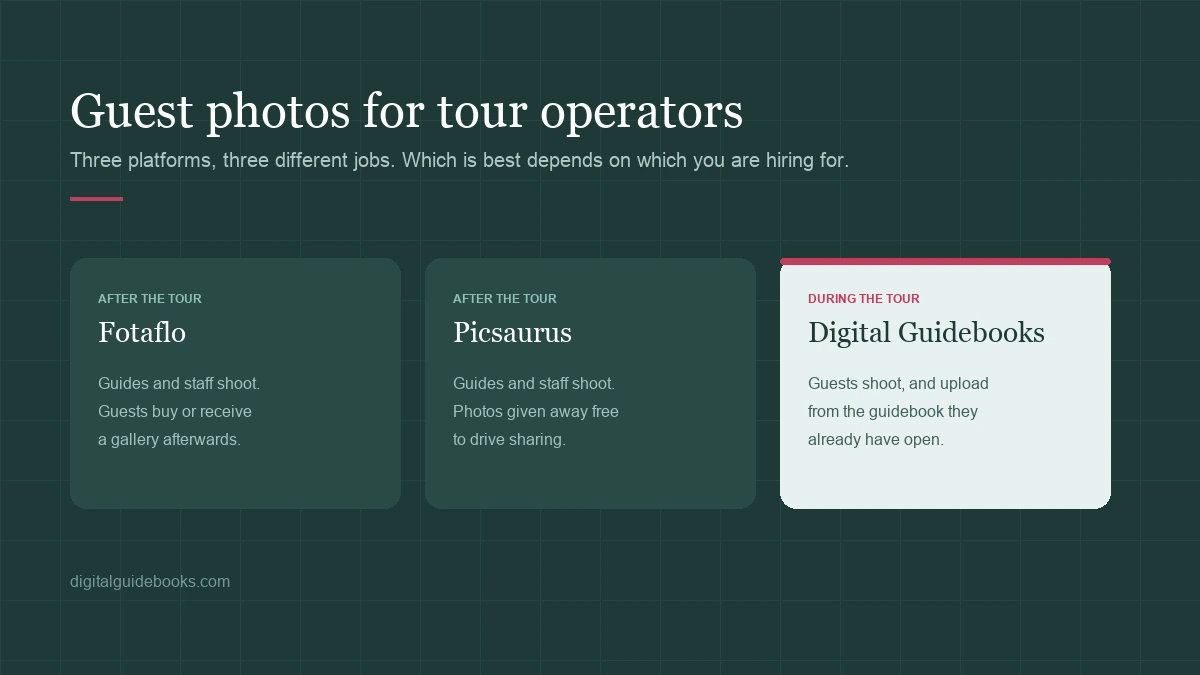
If you have started looking at guest photo software, you have probably noticed that the category does not agree with itself. Fotaflo, Picsaurus, PicThrive, Wherewolf and a handful of others all describe themselves as solving guest photos, and they mean genuinely different things by it. Some sell photographs to guests. Some give them away. Most hand the camera to the guide. One hands it to the guest.
So "which one is best" does not have a general answer. It has an answer for you, and it depends almost entirely on which job you are actually hiring for: do you want a considered set of images taken by somebody whose job it was, or do you want what your guests already photograph anyway.
This compares three of them, one of which is ours, and tries to be straight about where we are not the right choice.
Fotaflo is a photo and video delivery platform built for experience operators. Guides and staff capture photos during the experience, and guests receive a gallery afterwards. Those photos become a marketing touchpoint: guests share them, leave reviews prompted by the delivery email, and sometimes rebook from the gallery page. It is the most established of the three and the most photography-led.
Picsaurus works the same way at capture but is built around giving the photos away rather than selling them. The pitch is reach rather than revenue: guests get their pictures free, post them, and tag the operator. Delivery runs off the booking record.
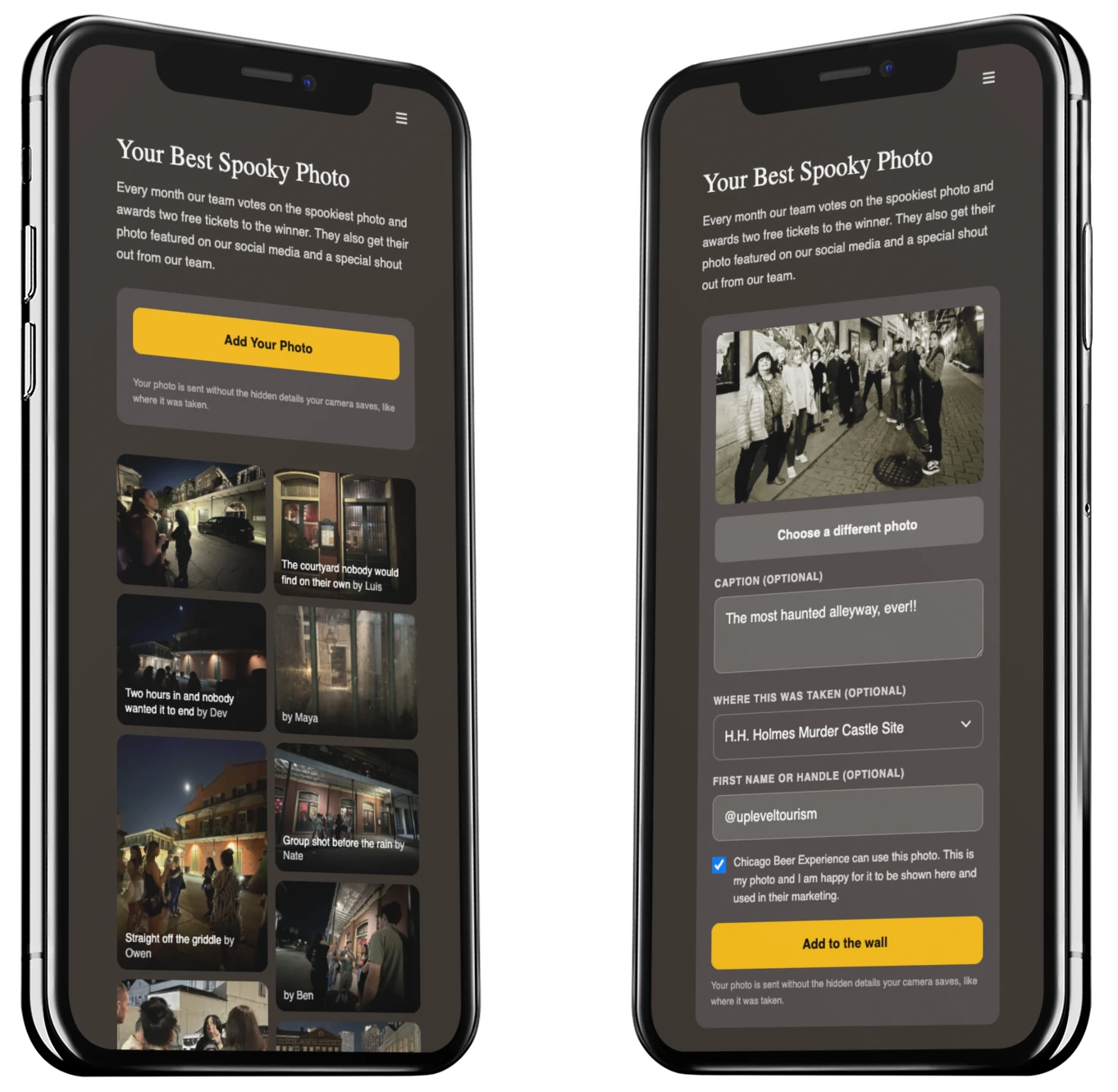
Digital Guidebooks is a mobile-first companion guests use during the experience. They scan a QR code, follow along stop to stop, and the platform captures emails, enables digital tipping, prompts reviews and collects feedback along the way. Photos are one page inside that: guests upload their own, from their own phones, and see everyone else's immediately.
Which points at the difference in timing that runs through everything below. Two of these live in the hours after an experience wraps. One lives in the hours while it is happening.
Side-by-side comparison
| Capability | Fotaflo | Picsaurus | Digital Guidebooks |
|---|---|---|---|
| What it is for | Photo marketing and photo sales | Giving guest photos away | Engagement during the experience |
| Primary timing | Post-experience | Post-experience | During experience |
| Who takes the photos | Guides and staff | Guides and staff | Guests, from their own phones |
| Work asked of the guide | Capture, assign, deliver | Capture and deliver | None |
| Full-resolution originals | Yes | Yes | No, a display copy only |
| Email capture | Photo delivery opt-in | From the booking record | Gated access with local/visitor segmentation |
| Review generation | Post-delivery email prompt | Post-delivery prompt | In-experience prompt at peak emotion |
| Digital tipping | Not included | Not included | Per-guide tip pages (Venmo, Cash App, PayPal) |
| Guide tools | Photo upload and tagging | Photo upload and delivery | Profile, recommendations, tipping, onboarding |
| Media format | Photo and video galleries | Photo and video galleries | Text, photos, maps, and interactive stop pages |
| Guest access | Email link (no app required) | Link passed from the booker | QR code or link (no app required) |
| Guest feedback | Not included | Not included | Built-in survey at end of experience |
Two of those rows are the whole article, and they point in opposite directions. Fotaflo and Picsaurus put a camera in a guide's hands and deliver the results afterwards, which is a real job that Digital Guidebooks does not do. Digital Guidebooks asks the guest to do it, during the tour, and asks nothing of the guide at all.
The memory layer vs. the engagement layer
Fotaflo gives guests a keepsake. The photos arrive after the experience, and they serve as a visual reminder of the day. That reminder drives social sharing, which extends the operator's reach. A guest who posts an experience photo on Instagram is doing free marketing, and Fotaflo makes it easy for that to happen consistently.
Digital Guidebooks gives guests a tool they use in the moment. The guidebook is open on their phone while the experience is underway. They reference stop details, read about the next location, check the map, and interact with their guide's profile. The engagement happens in real time, which means the platform can capture actions (tips, reviews, emails, feedback) at the point of highest intent.
Picsaurus sits on the same layer as Fotaflo and differs in the business model rather than the mechanism. Where Fotaflo can treat photographs as something to sell, Picsaurus treats them as something to give away in exchange for reach: the guest gets their pictures free, posts them, and tags the operator. Same keepsake, different theory of what it is for.
These layers complement each other rather than compete. The memory layer reinforces the brand after the guest leaves. The engagement layer captures value while the guest is still present. Operators building a complete tech stack often find room for both.
Review capture timing
Fotaflo prompts reviews through the photo delivery email. The guest receives their photos, relives the experience through the images, and sees a prompt to leave a review. This approach works well because the photos rekindle the emotional high. The timing, however, depends on when the guest opens their email. That could be hours later, or the next day, or never. Over 90% of travelers read reviews before booking, which makes the volume and recency of reviews a genuine competitive advantage.
Digital Guidebooks prompts the review while the guest is still emotionally present. The review page appears in the guidebook flow right after the final stop, at the moment when satisfaction is at its peak. One tap takes the guest to Google, TripAdvisor, or Yelp. There is no email to open, no second session to initiate. The guest is already holding their phone with the guidebook open.
Picsaurus works on the same post-delivery timing as Fotaflo, with one wrinkle worth knowing: because free photos are the whole offer, the delivery email tends to get opened. A review prompt attached to something a guest genuinely wants is in a better position than one attached to an invoice.
None of these approaches is wrong. The post-delivery methods reach guests who would not have left a review in the moment. The in-experience method captures the guests who are ready to act right now. Running one of each gives an operator two distinct windows to generate reviews.
Email collection
Fotaflo captures emails as part of photo delivery. Guests provide their email to receive the gallery link. The operator gains a verified contact who has already attended the experience, which is a high-quality lead for remarketing.
Digital Guidebooks captures emails at the point of access, before the experience begins. Every guest who opens the guidebook enters their email and selects whether they are a local or a visitor. That segmentation is automatic. Operators can export their list at any time and send different campaigns to locals (who might rebook a different experience) and visitors (who might leave a review or refer friends back home).
Picsaurus takes a third route and works from the booking record, which means there is nothing to collect at all. That is the least friction of the three, and it is also the narrowest: a booking for six people carries one email address. The other five are reached only if the first person forwards the gallery.
So the three differ in timing, in friction, and in how many people they actually reach. Fotaflo collects after the experience with a photo incentive. Picsaurus collects nothing and inherits the booker. Digital Guidebooks collects before the experience with an access gate, from everybody. Operators running more than one end up with a fuller picture of their guest list, since some guests engage with the photos and not the guidebook, and the other way round.
What this means for your guides
The most practical difference between these platforms is the workload they place on your guides, and here the split is two against one.
Fotaflo depends on the guide to capture photos throughout the experience. The guide needs to know when and how to shoot, tag guests properly, and upload consistently. That is very achievable with a small, settled team who are into it. It gets harder the more guides you have and the more seasonal they are, because the result depends on every one of them doing it every time, and operators with large rosters do talk about adoption being the part they had to work at.
Picsaurus asks for the same thing, because it has to. Any product where staff take the photographs depends on staff remembering to take the photographs, and both companies have built real features to compensate: prompts, reminders, inactivity timeouts, and in Fotaflo's forthcoming rebuild a popup for when a guide closes an album without assigning anybody to it. Those exist because the workflow asks something of a person who is already working.
Digital Guidebooks requires nothing extra from the guide during the tour. The content is already built into the guidebook before the experience starts. The guide simply shares a QR code at the beginning and tells the group to scan in. From there, the guidebook runs itself. Archival photos, maps, stop descriptions, local recommendations, tipping prompts. All of it is already loaded. The guide focuses on what they do best: telling the story.
For operators who have tried binders, laminated cards, or printed handouts, the guidebook replaces all of that with something guests actually keep on their phone after the tour ends. No printing, no reprinting, no guides forgetting to bring the materials.
Capturing every guest, not just the booker
A common challenge for operators, especially those receiving guests through cruise ships or third-party booking platforms, is that they only get a headcount. Fifteen adults and two children. No names, no emails, no way to follow up. The person who booked is the only contact in the system.
All three platforms address this differently, and this is the single sharpest difference between them. Fotaflo captures emails through the photo delivery opt-in. Picsaurus works from the booking record, which is efficient and also means it starts with one address for a party of fifteen, and relies on that one person to pass the link along to everybody else. Digital Guidebooks captures emails at the start of the experience, before the guidebook opens. The guide says "everybody grab this right now" and within 30 seconds, every guest in the group has entered their email and is browsing the guidebook. That single moment turns an anonymous group of 15 into 15 individual contacts with email addresses, segmented by local or visitor.
Whether that matters depends entirely on what you want afterwards. If the goal is to get photos into the hands of a family, the booker forwarding a link works fine, and the family is generally happy to receive it. If the goal is a mailing list of people who chose to be on it, a link forwarded by somebody else does not produce one.
The trade Digital Guidebooks makes on the photos themselves
Worth stating plainly, because it is the clearest thing the other two do better. Fotaflo and Picsaurus keep the full-resolution original. Digital Guidebooks does not. The browser resizes each photo before it uploads, the operator gets a display copy, and the original never leaves the guest's phone.
The photo wall write-up covers how that upload works in practice. That is a deliberate decision about holding other people's data rather than a limitation waiting to be fixed. Guest photographs are personal, storing the originals means holding a lot more of something that belongs to somebody else, and the version an operator actually uses on a website or in a post does not need to be a print master. But it does mean that if the plan is to sell prints, or hand a client a folder of full-size files, that is not what this is.
A note on Fotaflo 4
Fotaflo announced a complete rebuild of its iOS and Android apps in August 2026: a native interface, an album-based capture workflow, booking search, and automatic detection of online travel agency booking emails so a guide captures the guest's real address rather than a relay one. That last feature is a genuinely good answer to a problem every operator taking OTA bookings knows well.
At the time of writing it has not shipped, and Fotaflo are still asking for beta testers. This comparison describes the versions available today, and will be updated when the rebuild lands.
When Fotaflo is the right fit
Fotaflo is built for operators whose experiences produce strong visual content. Adventure operators, scenic experiences, food experiences with photogenic plating, wildlife encounters, and any activity where a professional photo adds genuine value to the guest's memory. If your guests would share a great photo from the experience, Fotaflo turns that impulse into a system.
It is also a strong fit for operators who already have tipping and review workflows in place and want to add a post-experience marketing layer. The photo gallery becomes a brand touchpoint that keeps working long after the guest goes home.
When Picsaurus is the right fit
Picsaurus is built around giving photos away rather than selling them, which makes it a natural fit for operators who see photography as marketing rather than a revenue line. If the point is that guests leave with something they will post, and that the operator gets tagged when they do, that is exactly the job it does.
It suits operators whose bookings come with reliable contact details and whose groups are mostly families or couples, where one person forwarding a gallery reaches everybody who wants it. It also holds the full-resolution files, so an operator who wants a genuine archive of their season has one.
When Digital Guidebooks is the right fit
Digital Guidebooks is built for operators who want to capture tips, emails, reviews, and feedback from a single tool that guests use during the experience. Walking tours, food tours, history tours, pub crawls, and any guided group activity where guests carry their phones benefit from a live guidebook.
It is a particularly strong fit for operators who want to elevate their experience with rich content that a guide simply cannot carry. Archival photos, historical images, behind-the-scenes footage, vintage maps. The guide tells the story while the guest holds the proof on their phone. It sets expectations from the start and creates a controlled, consistent experience regardless of which guide is leading that day.
It is also ideal for operators whose guides rely on tips as a meaningful part of their income. The dedicated tipping page, personalized with the guide's name and photo, removes the friction of cash-only tipping. Guides keep 100% of every gratuity.
Using both platforms together
Operators with a strong visual product often run two of these side by side. Digital Guidebooks handles the during-experience engagement: email capture at the start, stop-by-stop content throughout, and tipping, reviews, and feedback at the end. A photo platform handles the post-experience follow-up: professional delivery, social sharing prompts, and a second review window.
The tools do not overlap much in function or timing. They address different moments in the guest journey, collect different types of data, and drive different outcomes. An operator does not need to choose between them any more than they need to choose between a booking platform and an email marketing tool. Each one does its job in its own phase.
The one place they do meet is guest photographs, and even there the overlap is smaller than it looks. A photo platform produces a considered set of images taken by somebody whose job it was. A guidebook photo wall produces whatever fifteen people on a Saturday felt like taking, immediately, in front of each other. Those are different things, and an operator who wants both is not being indecisive.
See what Digital Guidebooks does during the experience.
Plans start at $99 a month, and every one comes with a 60-day money-back guarantee.
View Pricing →