

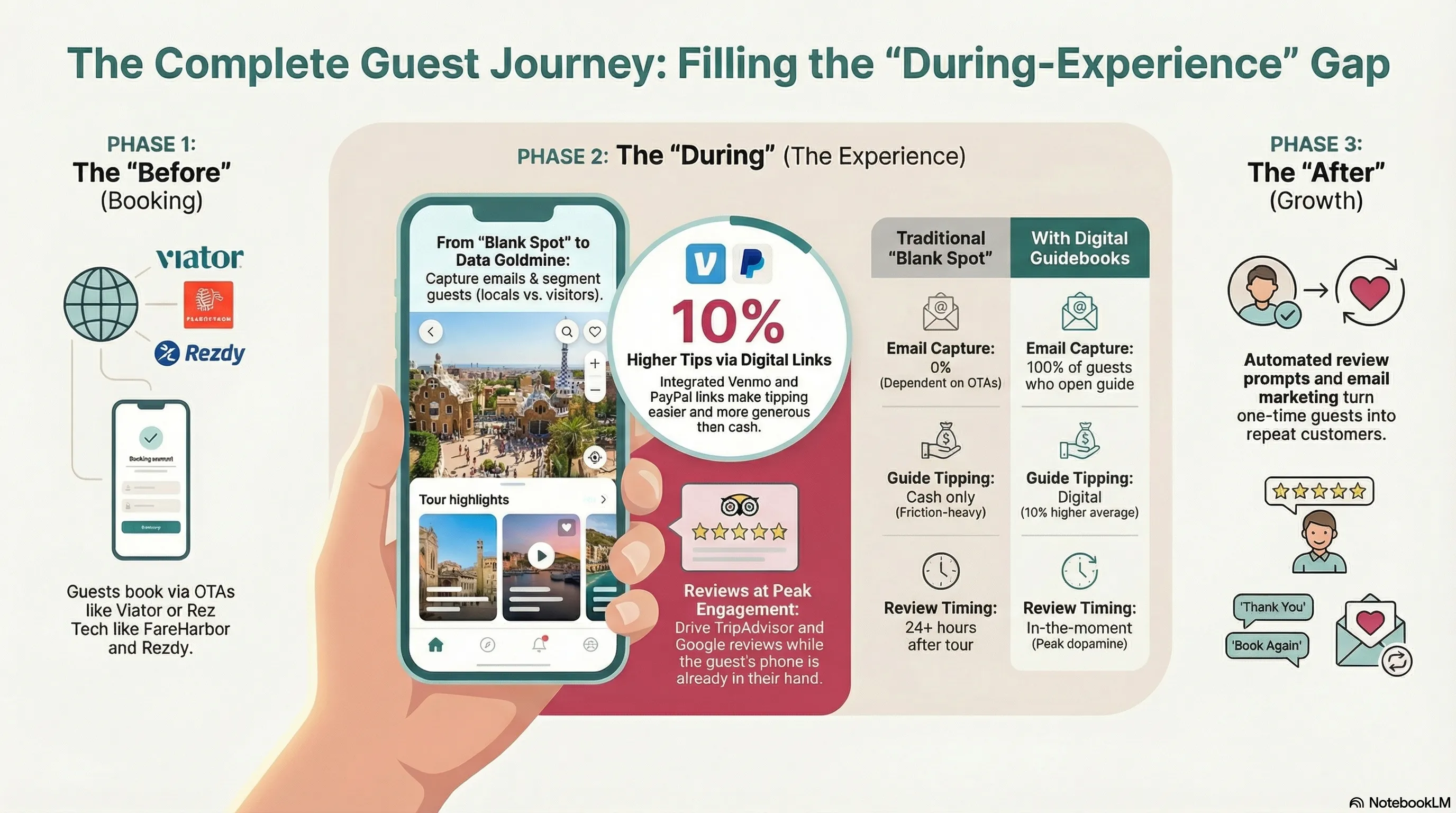
Most tour operators have a booking platform, an email tool, a waiver or check-in solution, and some version of review follow-up. They have built a before and an after. Before: reservations, confirmations, pre-arrival communication, guest check-in. After: review requests, follow-up emails, photo delivery. The during column is almost always empty.
The question is not whether an operator needs software. Every operator already uses it. The question is whether the software they have matches the jobs that actually need doing, and whether any of those tools address the window when guests are standing in front of them, phone in hand, emotionally engaged, and ready to act.
The before stack
Booking platforms handle reservations and payments. FareHarbor, Peek Pro, Starboard Suites, and TripWorks are the names most operators know. These tools are the industry standard, and most operators already have one. The booking platform is the first piece of software an operator adopts, and it does its job well: accept money, confirm the reservation, send a receipt.
Waiver and check-in tools handle pre-arrival communication and guest data collection. Wherewolf is the most recognized name in this category. These tools send pre-arrival messages, collect dietary and allergy information, and gather guest details from every person in a group, not just the lead booker. They solve the anonymous guest problem before the experience starts.
CRM platforms and email tools handle the follow-up sequence. ActiveCampaign, Mailchimp, and other marketing automation platforms manage post-visit emails, drip campaigns, and list segmentation. These tools are well-understood and widely adopted.
These before tools do their jobs well. The challenge is not that they are inadequate. It is that they address a completely different part of the guest journey than the experience itself. An operator with a full before stack and a full after stack still has nothing running during the two or three hours when guests are present.
The pre-arrival communication gap is worth naming specifically. One food experience operator stopped using waivers entirely after her insurance agent confirmed they were legally unnecessary. The result was a cleaner guest arrival and a better first impression. But the data she had been collecting through that process disappeared with the form. The waiver had been doing two jobs: legal protection and data collection. Only one of those jobs was the reason she used it. The other was a side effect she did not notice until it was gone.
Most operators are not sharing their actual tour sales pages or pre-trip communication with the guides on the ground. The disconnect between what the operator promises on the booking page and what the guide delivers is a before-stack problem that no booking platform or waiver tool addresses. The information exists. It is just not reaching the person who needs it most.
The after stack
Review request emails, photo delivery through tools like Fotaflo, and follow-up sequences. These exist. Most operators have some version of an after stack, even if it is just a manual email sent the next morning.
The challenge is timing. By the time the follow-up arrives, the emotional peak has faded. The guest who was moved at stop four is now back at their desk, answering work emails. The review request feels like one more thing to do. The tip prompt feels like an invoice. Review rates drop. Tip amounts shrink. The after tools are only as effective as the window they operate in, and that window gets smaller every hour after the experience ends.
The during stack
The during column is the window when guests are present, phone in hand, emotionally engaged. It is the moment when a tip prompt converts on genuine feeling rather than obligation. It is when a review request captures something authentic rather than a polite summary written the next morning. It is when an email capture happens naturally, because the guest is already interacting with a tool that gives them value in return.
Almost no dedicated tool exists for this window. Operators address it with verbal asks, paper handouts, and hope. The guide mentions Venmo at the end. The operator hands out a printed card. Someone remembers to ask for a review. The during-experience infrastructure, in most operations, is a collection of manual habits that depend on the guide remembering to do them.
"It is connecting them to your experience before you even go on it. Nothing does that. Everything else is just capturing information. This is very customer centric. And I think that is the game changer right there."
Midgi Moore, Juneau Food Tours
The during tool is also the only one that can carry the experience itself rather than a record of it. Stops hold mixed media, including audio. A food stop shows what that particular tour is tasting, with allergens attached, which quietly removes a stack of pre-experience emails. And a photo wall collects the pictures guests take anyway and hands them back to the operator, sorted by venue.
The window between booking and arrival is also where trust is formed or quietly lost. Most operators do not think about this window deliberately. They assume the confirmation email is enough. But the guest's experience of the operator starts well before the guide says hello.
Before guests arrive, they have already formed most of their opinion about the operator. They have either had a smooth, clear lead-up to the experience, or a bumpy, silent, confused one. That pre-arrival window is where trust is won or lost.
How to evaluate your own stack
A simple framework: for each tool in the stack, name the job it is doing and name when in the guest journey it does that job. If every answer is before or after, the during column is empty. That is not a failure of the tools. It is a gap in the stack itself.
The decision on what to fill that gap with starts with identifying what is costing the most right now. If reviews are the problem, the during window is likely where the fix lives, not a new post-visit email sequence. If tips are inconsistent, the guide asking verbally at the end of a full and satisfied group is not the optimal moment. A prompt during the experience, when the feeling is live, is.
"The texting software was a minimum of $500 to $700 a month and you had to sign an annual contract. When you work seasonally, I am not spending $6,000 a year to use that technology for five months of the year."
Midgi Moore, Juneau Food Tours
The cost of patching the during gap with tools built for other jobs is real. Texting platforms, shared Venmo accounts, printed QR cards, follow-up email sequences that try to recreate a moment that has already passed. Each workaround adds cost and complexity without addressing the fundamental timing problem. A full breakdown of tour operator software costs shows how quickly the patchwork adds up.
The best experiences do not start when the guide says hello. They start when the guests feel ready.
A decision framework
Start with whatever phase is causing the most friction right now. Most operators already have booking covered. The money is moving. Most have some version of before and after. The confirmation email goes out. The review request follows up. These are solved problems with established tools.
The during column is almost always the one that has never been addressed with any dedicated tool. It is also the one where the highest-value moments happen. The guest at the emotional peak of the experience. The group that just shared a meal together. The moment after the guide tells the story that makes the room go quiet. These are the moments when a tip prompt converts, a review captures something real, and an email address is given willingly because the guest is getting something valuable in return.
The operators who recognize that gap and fill it with a purpose-built tool will capture more value from every experience they already run. The operators who continue to patch it with before and after tools will keep paying more for less.
Frequently Asked Questions
What software do most tour operators use?
Most tour operators use a booking platform (FareHarbor, Peek Pro, or Starboard Suites), an email marketing tool (Mailchimp or ActiveCampaign), and some form of waiver or check-in system. These tools cover the before and after phases of the guest journey. The during-experience phase is almost always unaddressed by any dedicated software.
Do I need a booking platform and a guidebook platform?
Yes. They do different jobs at different points in the guest journey. A booking platform handles reservations and payments before the experience. A digital guidebook handles email capture, tipping, reviews, and guest engagement during the experience. They are complementary, not redundant.
What is the difference between a waiver tool and a guidebook tool?
A waiver tool collects guest data and legal consent before the experience starts. A guidebook tool engages guests during the experience itself, capturing emails, facilitating tips, prompting reviews, and delivering content. Some operators use both because they address different phases and different needs.
How much does tour operator software cost?
A mid-size tour operator can easily spend $1,500 to $2,500 per month on software across booking, email, waiver, review, and communication tools. Seasonal operators feel it most, because every tool has to earn back its yearly cost in the months they are open. A full cost breakdown is available in our tour operator software cost guide.
Fill the gap in your stack.
Plans start at $99 a month, and every one comes with a 60-day money-back guarantee.
See Plans →